

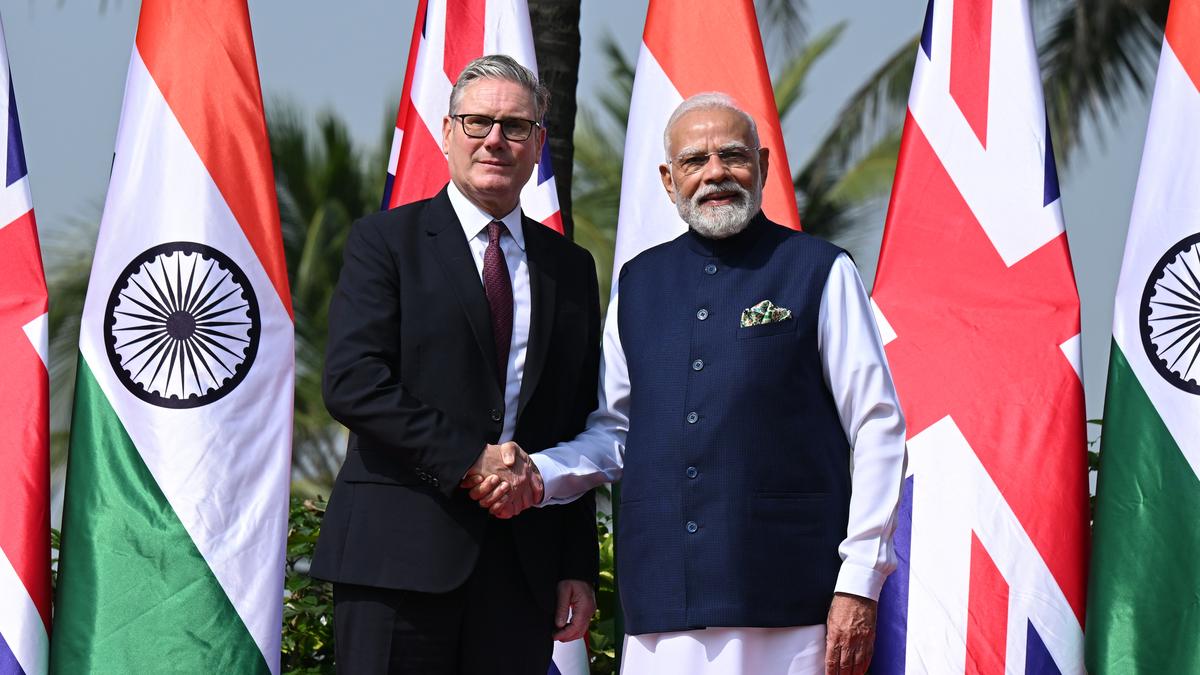
NEW DELHI: India and the United Kingdom on Thursday unveiled an expansive roadmap to deepen cooperation across trade, technology, education, and defence, reaffirming their commitment to a rules-based global order and a modern, forward-looking partnership.
The announcement came at the conclusion of British Prime Minister Keir Starmer’s first official visit to India during 8–9 October, when he and Prime Minister Narendra Modi outlined a renewed strategic direction anchored in the recently-signed India–UK Comprehensive Economic and Trade Agreement (CETA).
As per a joint statement, the two leaders agreed to fast-track the ratification of the CETA and reposition the Joint Economic and Trade Committee (JETCO) as the central mechanism to oversee its implementation. The agreement, both sides said, is expected to create new economic opportunities in priority sectors including clean energy, advanced manufacturing, defence, education, science, and digital innovation.
The high-level British delegation, which included Secretary of State for Business and Trade Peter Kyle and over 125 business and institutional leaders, underscored the UK’s renewed economic outreach to India. Both governments described the visit as a defining moment for bilateral relations, with India now seen as a key growth engine for global trade and investment.
At the core of the partnership lies a major expansion of India–UK cooperation in science, innovation, and frontier technologies. Both sides announced the establishment of the India–UK Connectivity and Innovation Centre—a joint hub to develop AI-native networks for 6G and cyber-secure telecom infrastructure, with £24 million in initial joint funding, as per the joint statement issued by the Indian Prime Minister’s Office on Thursday.
They also launched the India–UK Joint Centre for AI to promote responsible and trustworthy AI applications in healthcare, climate technology, fintech, and engineering biology. A new Critical Minerals Industry Guild was also announced to secure resilient mineral supply chains, backed by Phase II of the UK–India Critical Minerals Supply Chain Observatory, which will open a new satellite campus at IIT-ISM Dhanbad.
In climate cooperation, the two leaders unveiled a Climate Technology Startup Fund under an a memorandum of understanding between the British government and the State Bank of India. The fund will support startups in clean technology, climate innovation, and AI-driven solutions for sustainability. They also launched a joint Offshore Wind Taskforce and committed to explore collaborations through the Global Clean Power Alliance (GCPA).
In a major boost to the education and knowledge partnership, both Modi and Starmer welcomed the progress made by UK universities in establishing branch campuses in India. The University of Southampton has begun classes at its Gurugram campus, while new Letters of Intent were handed over to Lancaster University for Bengaluru and the University of Surrey for GIFT City. The University Grants Commission (UGC) has also cleared approvals for Liverpool, York, Aberdeen, and Bristol universities to operate in India, with Queen’s University Belfast, and Coventry University expanding in GIFT City in Ahmedabad.
This move is seen as part of India’s effort to internationalise higher education and attract global talent and investment in research and innovation. The two sides also announced the Annual Ministerial Strategic Education Dialogue to strengthen academic collaboration, mobility of students, and skills partnerships.
On defence and security, India and the UK agreed to deepen bilateral exchanges between their armed forces through training, joint exercises, and technology partnerships. Prime Minister Modi welcomed the upcoming visit of the UK’s Carrier Strike Group and the continuation of Exercise KONKAN between the two navies.
Both leaders agreed to finalise an Inter-Governmental Agreement (IGA) on developing maritime electric propulsion systems for Indian Naval platforms and confirmed the government-to-government route for the supply of Lightweight Multirole Missile (LMM) systems. This collaboration will not only strengthen India’s air defence capabilities but also support long-term industrial partnerships under Atmanirbhar Bharat.
They also announced plans to establish a Regional Maritime Security Centre of Excellence under the Indo-Pacific Oceans Initiative (IPOI), aimed at improving maritime domain awareness and regional security cooperation.
The two leaders also issued a joint statement against terrorism, calling for “zero tolerance” toward extremism and reaffirming their commitment to take decisive actions against proscribed terrorist groups and their sponsors. They condemned the April 2025 terrorist attack in Pahalgam and agreed to enhance cooperation in counterterrorism financing, intelligence sharing, and capacity building.
Both governments reaffirmed their shared commitment to achieving net-zero goals and promoting green growth. They welcomed the India–UK Climate Finance Initiative designed to scale up climate investments, particularly through the mobilisation of private capital.
The leaders also discussed expanding cooperation in biotechnology, where institutions such as the Centre for Process Innovation (UK), Biotechnology Research and Innovation Council (India), and the Henry Royce Institute will collaborate on breakthroughs in biomanufacturing, 3D bioprinting, and genomics.
At a global level, India and the UK pledged closer collaboration at the UN and other multilateral fora. The UK reaffirmed its support for India’s bid for a permanent seat on a reformed UN Security Council. Both sides also expressed concern over the ongoing conflict in the Middle East and reiterated their support for peace in Gaza, backing efforts to achieve an immediate ceasefire and humanitarian aid delivery.
Modi described the visit as “the beginning of a new era of cooperation” between two vibrant democracies, while Starmer called India “an indispensable global partner” in shaping future trade, innovation, and climate action.
Starmer’s visit, which came less than three months after the signing of the India–UK CETA, marks the transition from negotiation to execution. With the UK now seeking deeper ties with Asia post-Brexit, and India consolidating its position as a hub for manufacturing and innovation, both sides see the partnership as pivotal to their long-term strategic and economic interests.
The text of Joint Statement:
At the invitation of Prime Minister Narendra Modi, Keir Starmer, Prime Minister of the United Kingdom paid an official visit to India from 08-09 October 2025. Prime Minister Starmer was accompanied by a high-level delegation including Secretary of State for Business and Trade and President of the Board of Trade the Rt Hon Peter Kyle MP, Secretary of State for Scotland the Rt Hon Douglas Alexander MP, Minister for Investment Mr. Jason Stockwood, and 125 CEOs, entrepreneurs, university Vice Chancellors and cultural leaders.
This is Prime Minister Starmer’s first official visit to India. The visit follows the visit of Prime Minister of India to the United Kingdom on 23–24 July 2025, during which both sides signed the historic India–UK Comprehensive Economic and Trade Agreement (CETA) and adopted the India – UK Vision 2035 and a Defence Industrial Roadmap.
Prime Minister Modi and Prime Minister Starmer delivered keynote addresses at the Global Fintech Fest in Mumbai on 09 October 2025. The Leaders held restricted as well as delegation-level talks in Mumbai on 09 October 2025, where they expressed satisfaction at the upward trajectory of the India-UK Comprehensive Strategic Partnership and reaffirmed common commitment to global peace, stability, and a rules-based international order. They also discussed global and regional issues of mutual interest.
The Prime Ministers welcomed the meeting of the CEO Forum in Mumbai on the sidelines of the India-UK Summit. Both leaders looked forward to the ratification of the India–UK Comprehensive Economic and Trade Agreement (CETA) as early as possible to realise its benefits.
The Prime Ministers also welcomed the resetting of the Joint Economic and Trade Committee (JETCO) which will support the governance and utilisation of the CETA and drive forward our wider trade and investment partnership.
The strong business delegation accompanying UK Prime Minister demonstrated the opportunities for investment in both countries in the focus sectors of construction, infrastructure and clean energy, advanced manufacturing, defence, education, sport, culture, financial and professional business services, science, technology and innovation, consumer goods and food. The existing UK India Infrastructure Financing Bridge (UKIIFB), between NITI Aayog and City of London Corporation, is an example of our shared ambitions for sustainable growth.
Both Prime Ministers reiterated their commitment to improving connectivity and enhancing cooperation in the aviation sector and welcomed that both sides are discussing the renewal of India-UK Air Services Agreement, along with other aviation related matters. This provides an opportunity for both countries for closer cooperation across the aerospace sector.
The Prime Ministers of India and the United Kingdom reaffirmed their shared commitment to harnessing frontier technologies to drive inclusive economic growth, strengthen national security, and shape the future of global innovation. Building on the landmark Technology Security Initiative (TSI), both leaders welcomed the tangible progress made across critical and emerging technologies, including telecommunications, critical minerals, AI, and health tech.
Under the TSI, the leaders expressed happiness at the establishment of:
• The India–UK Connectivity and Innovation Centre, a joint hub focused on developing AI native network for 6G, Non-Terrestrial Networks (NTNs), and cyber security for telecoms, with at least £24m of joint funding in the first phase of the project.
• The India–UK Joint Centre for AI, advancing responsible and trustworthy AI across health, climate, fintech, and engineering biology.
• UK – India Critical Minerals Processing and Downstream Collaboration Guild to build concrete partnerships which strengthen and diversify critical mineral supply chains and deliver investment and growth in both nations. They also announced Phase 2 of the UK-India Critical Minerals Supply Chain Observatory to expand Mineral coverage, further integrate advanced technologies, unlock new bilateral investment opportunities and establish a new satellite campus at IIT-ISM Dhanbad.
The UK and India continue to work together to advance biotechnology with strategic partnerships being signed between institutions like Centre for Process Innovation (CPI) UK and Biotechnology Research and Innovation Council (BRIC) institutions in India, Henry Royce Institute (HRI) and Indian Institute of Science (IISc), Oxford Nanopore Technologies (ONT) and BRIC – Centre for DNA Fingerprinting and Diagnostics (BRIC-CDFD), to deliver transformative outcomes in Biomanufacturing, 3D Bioprinting, and Genomics.
The Leaders agreed to expand bilateral exchanges between the armed forces of India and UK through joint exercises, training and capacity building. Prime Minister Modi welcomed the port call of UK’s Carrier Strike Group and the Royal Navy’s exercise KONKAN with the Indian Navy. Both sides committed to robust maritime security collaboration in the Indo-Pacific, including establishment of the Regional Maritime Security Centre of Excellence (RMSCE) under the Indo-Pacific Oceans Initiative (IPOI).
In the context of cooperation on training, the two Leaders welcomed progress on an arrangement that will see Indian Air Force Qualified Flying Instructors integrated into UK Royal Air Force training, alongside an agreement that will facilitate our strong training and education relationship.
Both Prime Ministers are pleased to the intent to finalize an India – UK Inter-Governmental Agreement (IGA) on cooperation in developing maritime electric propulsion systems for Indian Naval platforms.
Both leaders also announced the agreement to proceed via government to government route on an initial supply of Lightweight Multirole Missile (LMM) systems. This will further support India’s air defence capabilities and, in the spirit of Atmanirbhar Bharat, meet the current and future requirements of the Indian Ministry of Defence, and support a long-term collaboration on complex weapons between the two countries.
The two Prime Ministers unequivocally and strongly condemned terrorism and violent extremism in all its forms and manifestations. They called for zero tolerance for terrorism and concerted international efforts to combat terrorism in a comprehensive and sustained manner, in accordance with the UN Charter and international law. They agreed to counter radicalisation and violent extremism; combat financing of terrorism and the cross-border movement of terrorists; prevent exploitation of new and emerging technologies for terrorist purposes; tackle terrorist recruitment; enhance cooperation in information sharing, judicial co-operation, capacity building; and strengthen bilateral and multilateral co-operation in these spheres, including at UN and FATF. They condemned in the strongest terms the April 2025 terrorist attack in Pahalgam, Jammu and Kashmir. They committed to strengthen co-operation to take decisive and concerted actions against globally proscribed terrorists, terror entities and their sponsors.
The Leaders reaffirmed the importance of collaboration to achieve net-zero goals. The Prime Ministers welcomed the ‘India-UK Climate Finance Initiative’ to enable scaling up of climate finance, unlocking green growth and new financing opportunities for both countries They announced a new joint investment in the Climate Tech Start-up Fund. This strategic initiative, under the MoU between the UK Government and State Bank of India, will enhance support for innovative entrepreneurs working in frontier sectors such as climate technology and AI, driving innovation and fostering growth.
The Leaders welcomed the establishment of Offshore Wind Taskforce.They reiterated their intent to explore possibilities for working together through the Global Clean Power Alliance (GCPA).
The leaders underlined the importance of youth, cultural and educational exchanges in shaping the future of the bilateral relationship. They expressed commitment to the first Annual Ministerial Strategic Education Dialogue, and the implementation of the Programme of Cultural Co-operation signed by both Ministers of Culture in May 2025.
Acknowledging education as a key area of bilateral cooperation, both sides expressed happiness on the progress in opening of campuses of nine leading UK universities in India. The University of Southampton has welcomed its inaugural cohort of Indian students to its campus in Gurugram.The University Grants Commission has also handed over Letters of Intent (LoI) for establishment of branch campuses of University of Liverpool, University of York, University of Aberdeen and University of Bristol in India. Further, Queens University of Belfast and Coventry University have been authorised to open their branch campuses in GIFT City. During the visit, Indian authorities also handed over the LoI for opening of campus of Lancaster University in Bengaluru and accorded in-principle approval for opening campus of University of Surrey in GIFT City.
The Prime Ministers expressed their commitment to continue implementing the Migration and Mobility Partnership (MMP). While noting the progress in cooperation for curbing irregular migration, both sides reiterated their commitment to continue collaboration in this domain.
Both Leaders recognised the Indian diaspora in the United Kingdom as a living bridge between the two countries and appreciated its contribution to strengthening bilateral economic, cultural, and societal links. The Leaders acknowledged the potential of the UK-India Programme of Cultural Cooperation to bring together the talent in both countries in the areas of Culture, Creative Industries, Arts, Tourism and Sports.
The Prime Ministers reiterated their shared commitment to global peace, prosperity and a rules-based international order. They agreed to work closely in promoting reformed multilateralism, including reform of the United Nations Security Council (UNSC). The UK reiterated its long-standing support for India’s legitimate aspirations for permanent membership in a reformed UNSC.
The Leaders acknowledged that the shared values of 2.5 billion peoples spread across diverse geographies constituting the Commonwealth was its strength. They agreed to work closely in the areas of Climate Change, Sustainable Development, and Youth Engagement with the new leadership at the Commonwealth Organisation.
The two Prime Ministers expressed support for a just and lasting peace in Ukraine in accordance with international law, including the UN Charter. They welcomed the ongoing diplomatic efforts by various countries to achieve this.
They reiterated their commitment to peace and stability in the Middle East, calling for restraint, protection of civilians and to comply with international law, and refrain from taking actions that could further escalate the situation and compromise regional stability. They expressed their support for the US peace plan for Gaza and their commitment to working with regional partners to secure an immediate and lasting ceasefire, the release of the hostages and the delivery of humanitarian aid, and their shared commitment to a lasting and just peace as a step towards a Two-State solution, with a safe and secure Israel, alongside a viable Palestinian state.
Prime Minister Starmer thanked Prime Minister Modi for the warmth and hospitality extended to him and members of his delegation. The visit reaffirmed the strong growth and positive trajectory of the India – UK Comprehensive Strategic Partnership which is built upon shared democratic values and deep and enduring bonds of friendship between the two countries.

