

DHAKA: Bangladesh is navigating a morass of political hurdles in the lead-up to its election set for early next year, including conflicting demands over proportional representation in parliament.
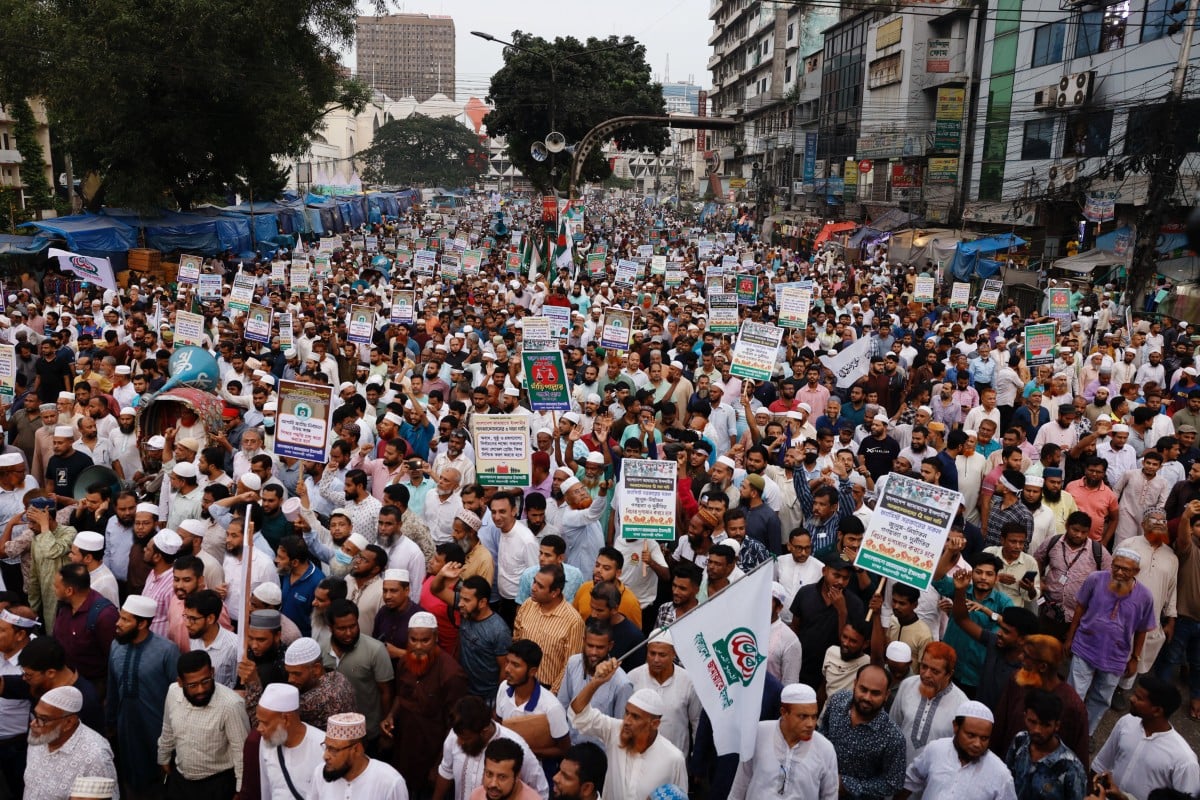
Both the country’s largest Islamist political party, Jamaat-e-Islami, and the newly formed National Citizen Party (NCP), which draws support from student leaders who toppled the previous regime of former prime minister Sheikh Hasina, have demanded that the coming poll be conducted on the basis of the new system, a report in the South China Morning Post said.
Opposed to the proposal are the Bangladesh Nationalist Party (BNP), the only other political group besides Hasina’s Awami League to previously govern the country. It sees the move as an attempt to dilute the chances of securing a majority share required under the existing electoral process.
Bangladesh is a parliamentary democracy in which citizens aged 18 and older elect members to the 350-seat parliament, including 50 seats reserved for women. The leader of the party with a majority of seats as a result of direct elections every five years becomes the prime minister and heads the government.
Historically, Bangladesh’s political landscape has been dominated by the BNP and the Awami League. After Hasina’s regime was toppled, the BNP is seen as the party with the strongest chance of establishing a new government.
The interim government of Nobel laureate Muhammad Yunus has been talking to different political parties about conducting elections based on the proportional representation system, a task that analysts say may not be easy since it will involve changing the constitution.
“Bangladesh’s interim government is trying to reinvent the wheel or place the cart before the horse. They need an elected government to make significant changes to the constitution,” said Christopher Blackburn, a British political and security analyst. “Yunus simply doesn’t have a legitimate mandate.”
Analysts say the interim government appears caught in a dilemma over the issue, given the outsize influence of student leaders who were instrumental in establishing Yunus after last August’s uprising against Hasina that forced her to flee the country.
Blackburn said the proportional representation system would help groups such as Jamaat and the NCP gain more seats in parliament, hence the friction with the BNP.
“Proportional representation is often criticised for creating weak coalition governments. Are Bangladesh’s politics mature enough to handle chaos? No, it’s clearly not,” he said.
Party-list proportional representation is the most commonly used version of the system. Each voter casts a vote for a single party, and each party is allocated seats based on its share of the vote.
According to Blackburn, proportional representation has worked well in Nordic countries such as Finland, Denmark, Sweden and Norway, where citizens have a high degree of trust in their governments.
“They work together to reach a consensus. They are relatively small countries in terms of population. They also have established welfare systems,” he said.
Bangladesh’s current first-past-the-post system can result in a winning candidate securing victory by getting a single vote more than the runner-up despite not obtaining more than 50 per cent of the polled votes.
But analysts warn the interim government may lack the legitimacy to conduct radical electoral changes and switch to a new voting system at a time of political uncertainty.
“It is a new concept in South Asia. First, you will have to amend the constitution if you want to introduce it in Bangladesh. If this is done, there could be unrest in the streets and the election process could be derailed,” said Priyajit Debsarkar, an analyst and author who specialises in the region.
Members of the National Citizen Party demonstrate in front of the residence of Bangladesh’s chief adviser in Dhaka on May 9 demanding a ban on the Awami League party. Photo: EPA-EFE
Members of the National Citizen Party demonstrate in front of the residence of Bangladesh’s chief adviser in Dhaka on May 9 demanding a ban on the Awami League party. Photo: EPA-EFE
Next year’s election is likely to be conducted amid signs of greater political fragmentation within the country.
“The BNP is focusing on grass-roots activities and candidate selection to prepare for elections. Jamaat is attempting to rebrand itself as a party for the youth,” Debsarkar said.
Analysts view the NCP and Jamaat as allied together against the BNP in the coming election.
“There are different power strands emerging within Bangladesh,” said Sreeradha Datta, an international relations professor at O.P. Jindal Global University in India’s Haryana state.
According to Datta, acting BNP chairman Tarique Rahman is seen as supporting a group of people within his party who are not part of the “old guard”, leading to discontent.
She added that internal bickering within the newly formed NCP also meant it was not “cohesive” as a unit.
The political scenario is also being complicated by uncertainty over which party the supporters of the Awami League will end up backing in the coming election. The Awami League is banned from contesting but still has substantial support among sections of voters.
Datta said the Awami League supporters could back Jamaat to dilute the chances of long-time rival BNP forming the government.

