

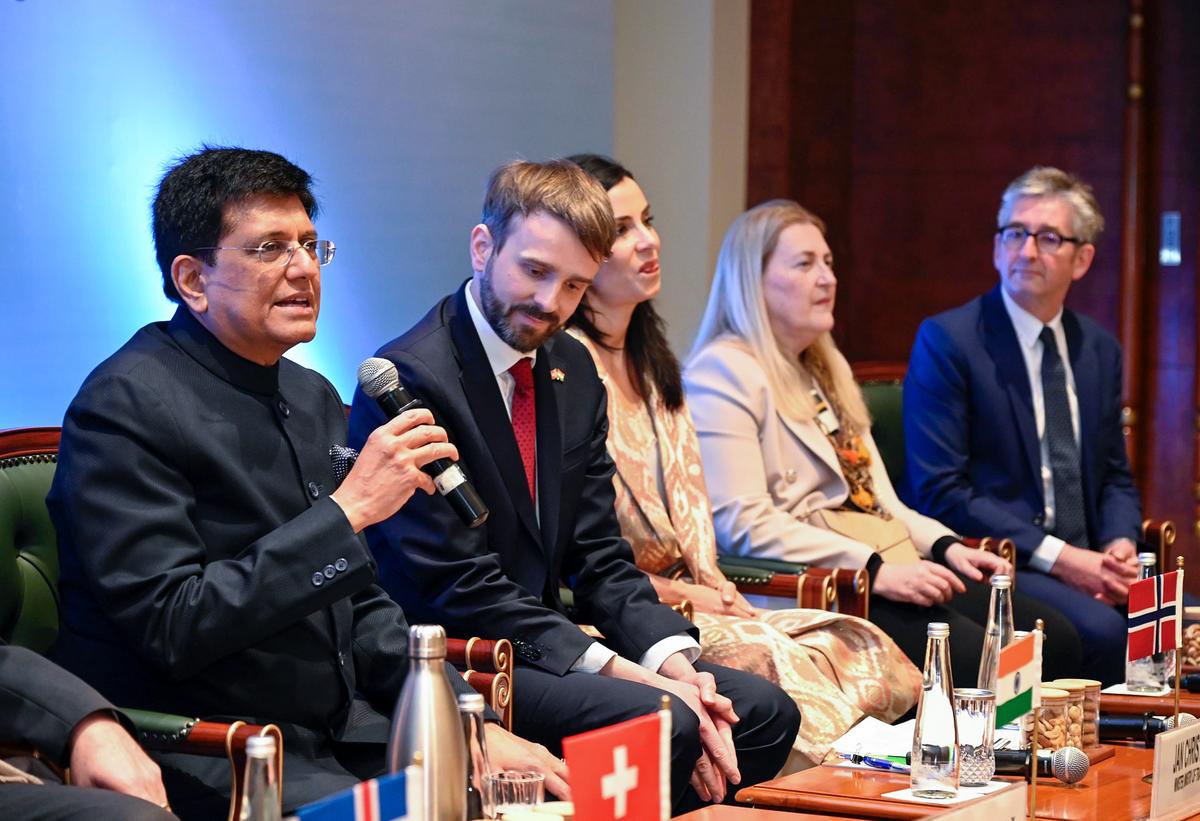
NEW DELHI: The free trade agreement between India and the four-nation European bloc EFTA came into force on Wednesday, under which the country has received an investment commitment of USD 100 billion over 15 years, while lowering or removing duties on products like Swiss watches and chocolates.
The Ministry of Commerce and Industry, in a statement, said that the agreement was signed on the 10th of March last year in New Delhi. EFTA is an important regional group with several growing opportunities for enhancing international trade in goods and services.
EFTA countries are Iceland, Liechtenstein, Norway, and Switzerland, and among them, Switzerland is the largest trading partner of India, followed by Norway. Trade and Economic Partnership Agreement is a modern and ambitious agreement that incorporates, for the first time in any Free Trade Agreement signed by India which is a commitment linked to investment and job creation. Our correspondent has the details.
Union Minister of Commerce and Industry, Piyush Goyal set the tone as he lauded the successful conclusion of the India-EFTA Trade and Economic Partnership Agreement (TEPA). He described the agreement as a defining moment in India’s economic engagement with Europe, stating that it represents “a trusted partnership between friends” built on mutual respect and sensitivities.Commerce and Industry Minister Piyush Goyal said the pact will unlock new opportunities for trade, investment and job creation, benefiting people and businesses.”Truly a historic day, as the India-EFTA Trade and Economic Partnership Agreement (TEPA) comes into force,” he said in a post on X.Together, India and the EFTA states represent a combined GDP of about USD 5.4 trillion, providing the scale for deeper integration.”The entry into force of the TEPA is a concrete step towards deepening the relationships between the EFTA states and India, building bridges and encouraging trade and investment,” a joint communique said.It provides enhanced market access and streamlines customs procedures, making it easier for Indian and EFTA businesses to expand their operations into growing markets, it added.
The Minister highlighted the pioneering nature of TEPA, pointing out that it is the first trade agreement to incorporate a firm investment commitment, thereby balancing interests and ensuring fairness between partners. He underscored that the entire population of the four EFTA countries is less than that of Mumbai city alone, yet the partnership is driven by the “big heart and tremendous potential” of the EFTA region.
Goyal emphasised the auspicious timing of the agreement, noting that its commencement on Navami, coinciding with Vijaya Dashami, symbolises prosperity, clarity and victory of good over evil. He described TEPA as a beacon of stability and certainty amidst global trade volatility, ambiguity and disruption.
The Minister underlined the wide-ranging opportunities opened by the agreement in diverse areas including: Life sciences, clean energy, precision engineering and food processing, Technology, artificial intelligence, accountancy and nursing, Education, audio-visual services, culture, tourism and recreation, Geothermal energy, where India looks forward to working with Iceland, Shipbuilding, repair, container manufacturing and maritime services in partnership with Norway, Innovation, R&D and advanced manufacturing in collaboration with Swiss and Liechtenstein companies
Goyal spoke about complementarities between Indian scale, aspirations and talent, and EFTA’s innovation and financial strength. He highlighted the role of India’s competitive cost structures, citing that data costs in India are only 3% of those in the US and less than 10% of the global average. He underlined the emergence of nearly 2,500 global capability centres in India that support Fortune 500 companies worldwide. The Minister recalled the legacy of Swiss companies like ABB and Nestlé in India and illustrated how India has not only provided a strong market base but has also become a hub for global expansion. He pointed out that the high price-to-earning ratios of companies like Nestlé India and ABB India reflect the immense potential and confidence of markets in India’s future growth.
Inviting businesses from EFTA nations, Shri Goyal assured them of India’s open, transparent and investor-friendly environment, with 100% FDI allowed in almost all sectors of interest. He encouraged partnerships of various kinds—equity, technical collaborations, or cooperative frameworks—to leverage India’s opportunities. He affirmed that the Government of India is committed to ensuring smoother, faster and more efficient pathways for investors.
Goyal underlined that TEPA is not merely about tariff reduction or investment commitment, but about establishing a stable, predictable and trusted framework that boosts investor confidence, reduces costs of uncertainty, and signals to the world that India and EFTA are committed to sustainable growth.
He further linked the agreement to India’s philosophy of Antyodaya (Integral Humanism), emphasising that prosperity must reach the last person at the bottom of the pyramid. He said that India’s partnership with EFTA nations will contribute to better quality of life, inclusive growth, sustainability and a stronger global economic order.
Goyal expressed gratitude to leaders, negotiators, industry representatives and officials who contributed to the conclusion of the agreement, including representatives from all four EFTA nations – Iceland, Liechtenstein, Norway and Switzerland. He acknowledged the tireless work of the negotiating teams, industry chambers such as CII, FICCI and ASSOCHAM, and Invest India for their valuable contributions in mobilising industry support and building confidence in the agreement. Concluding his address, Shri Goyal described TEPA as “an endless partnership” that marks only the beginning of a long, prosperous journey. He said it will continue for generations to come and lay the foundation of India’s deep engagement with Europe.
Swiss State Secretary for Economic Affairs, Helene Budliger Artieda said that this agreement is more than a legal document. “It is a win-win partnership for our countries. The strong presence of companies from Switzerland and other EFTA countries at today’s prosperity summit speaks for itself. These businesses are here because they believe in India and are ready to use the Trade and Economic Partnership Agreement. They see the potential, they want to invest, and they are ready to be part of India’s growth story. Swiss and Indian economies are complementary. The TEPA will bring these complementarities together for the benefit of both Switzerland and India”.
Speaking on the occasion, Commerce Secretary Rajesh Agrawal said that the operationalisation of the India-EFTA Trade and Economic Partnership Agreement (TEPA) is a strong signal of collective wisdom and will to strengthen free and fair trade. He observed that the agreement marks not just a trade arrangement but the beginning of a new era of shared growth, innovation and prosperity. Emphasising India’s emergence as the world’s fourth largest economy on course to becoming the third, he noted that the investment commitments under TEPA reflect global confidence in the India story.
Helene Budliger Artieda, State Secretary, Switzerland; May-Elin Stener, Ambassador of Norway; Christine Lingg, Deputy Director, Ministry of Foreign Affairs of Liechtenstein; and Ragnar Kristánsson, Director General, Ministry of Foreign Affairs of Iceland were present.
The implementation of the TEPA would be through laying sector roadmaps and deepening exports in engineering, pharma & med-tech, food processing, textiles/apparel and marine sectors. There would be outreach efforts for MSME onboarding with matchmaking and skills modules on quality, packaging and sustainability for tangible outcomes. There would be emphasis on facilitating logistics to reduce port dwell times and compress transit times. Both sides would monitor FTA utilisation, expanding investments, and services outcomes.
The TEPA harnesses the “Power of Five (Panch)”, clarifying roles and complementarities. India brings scale, demand and skilled talent. Switzerland brings precision manufacturing, finance and capital goods. Norway brings maritime competence and clean energy depth. Iceland brings niche clean-tech and digital ingenuity. Liechtenstein brings high-value manufacturing and specialized engineering. This partnership would strive to compound trade, investment and technology flows over the next two to three decades.
Market access and mobility improvements would open doors in EFTA countries for Indian farmers, MSMEs and entrepreneurs. Farmers and agri-marine exporters gain tariff advantages and premium-market positioning in specialty coffees, marine products and selected fresh and processed foods. MSMEs are expected to benefit from standards cooperation and lab-onboarding that would reduce duplicative testing and compliance costs, plus buyer–supplier matchmaking and skilling support. Services exporters gain clearer channels for digital delivery (Mode 1), commercial presence (Mode 3) and predictable professional mobility (Mode 4), with pathways for Mutual Recognition Agreements for professionals.
Business engagement at the Prosperity Summit led to several investment announcements by companies from EFTA countries. These included, The Prosperity Summit celebrated TEPA as a fair, mutually beneficial and balanced framework that connects India’s growth momentum to European markets. It sets a results-first agenda backed by clear principles, defined roles, and an execution pathway, aimed at translating market access and investments for creation of high quality jobs.
Domestic customers will get access to high-quality Swiss products, such as watches, chocolates, biscuits, and clocks, at lower prices, as India will phase out customs duties under the trade pact on these goods over 10 years.
The bloc committed an investment of USD 100 billion — USD 50 billion within 10 years after the implementation of the agreement and another USD 50 billion in the next five years — which would facilitate the creation of one million direct jobs in India.
This is a first-of-its-kind pledge agreed upon in any of the trade deals signed by India so far.
There is a provision in the pact, officially known as the Trade and Economic Partnership Agreement (TEPA), that if the proposed investments do not come because of certain reasons, India can rebalance or suspend the duty concessions to the four countries.
Under the pact, India is offering 82.7 per cent of its tariff lines or product categories, covering 95.3 per cent of EFTA exports, of which more than 80 per cent of imports are gold.
Sectors such as dairy, soya, coal and sensitive agricultural products are kept on the exclusion list, and there will not be any duty concessions on these goods.
In the services sector, India has offered 105 sub-sectors to the EFTA, like accounting, business services, computer services, distribution and health.
On the other hand, the country has secured commitments in 128 sub-sectors from Switzerland, 114 from Norway, 107 from Liechtenstein, and 110 from Iceland.
This is the fifth agreement of the Modi-led government. India signed pacts with Mauritius, the UAE, the UK, and Australia. Talks are at an advanced stage with the US, Oman, EU, Chile, New Zealand and Peru for FTAs.
India’s exports to the EFTA bloc rose by 1.22 per cent to USD 1.97 billion in 2024-25 from USD 1.94 billion in 2023-24.
Imports jumped to USD 22.44 billion in 2024-25 from USD 22.05 billion in 2023-24.
The two-way trade stood at USD 24.41 billion in the last fiscal. The trade gap is in favour of the bloc with a USD 20.47 trade deficit in 2024-25.
The biggest trading partner of India in the bloc is Switzerland (exports USD 1.47 billion and imports USD 21.8 billion in 2024-25), which already has zero customs duties on almost all industrial goods.
India has low trade volumes with the remaining three countries – Iceland (exports USD 66 million and imports USD 11 million in 2024-25), Liechtenstein (exports USD 0.41 million and imports USD 1.82 million in 2024-25), and Norway (exports USD 425 million and imports USD 632.8 million in 2024-25).
India has received USD 10.87 billion foreign direct investment (FDI) from Switzerland during April 2000 and June 2025. It was USD 54.07 million from Iceland, USD 110.26 million from Liechtenstein, and USD 941.81 million from Norway.
EFTA countries are not part of the European Union (EU). It is an intergovernmental organisation for the promotion and intensification of free trade. It was founded as an alternative for states that did not wish to join the European Community.
India is negotiating a comprehensive free trade agreement separately with the EU, the 27-nation bloc.

