

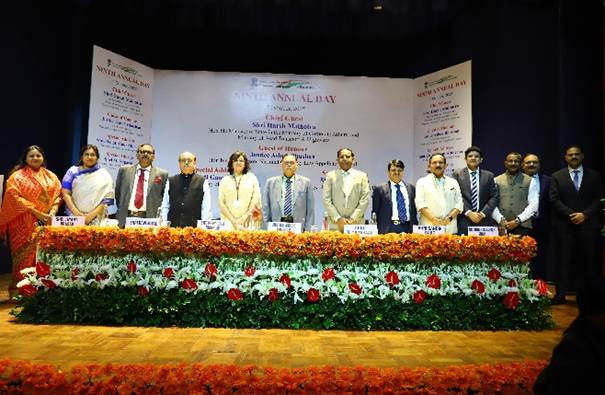
NEW DELHI: The Insolvency and Bankruptcy Board of India (IBBI) commemorated its 9th Annual Day on Wednesday, with a celebration of the significant strides made in India’s insolvency landscape since the introduction of the Insolvency and Bankruptcy Code (IBC).
Speaking at the function Justice Ashok Bhushan, Chairperson, National Company Law Appellate Tribunal
reflected on the stellar accomplishments of the Insolvency and Bankruptcy Code over the period of nine years and at the same time drew attention to the challenges that must be addressed to secure its continued efficacy.
In outlining the way forward for the insolvency ecosystem, he emphasised the need to augment institutional capacity, enhance value realisation through robust competitive bidding, and encourage the wider adoption of innovative platforms.
He lauded the IBBI for its proactive role as a regulator, one that constructively engages with stakeholders and nurtures research in insolvency law to underpin informed and evidence-based policymaking. He acknowledged IBBI’s meticulous and forward-looking regulatory approach, harmonised with the nation’s broader economic objectives, while underscoring the imperative of continuous innovation, sustained capacity building, and the strategic deployment of technology to facilitate timely admissions and expeditious resolutions.
To commemorate its establishment, the IBBI has instituted an Annual Day Lecture Series. Ms. Deepti Gaur Mukerjee, Secretary, Ministry of Corporate Affairs and M. Nagaraju, Secretary, Department of Financial Services, Ministry of Finance delivered the Annual Day Lecture this year.
In her address in the occasion, Deepti Gaur Mukerjee commended the Insolvency and Bankruptcy Board of India for the remarkable strides achieved in the IBC ecosystem within a relatively short span of nine years. She commended IBBI’s proactive approach in releasing over 90 discussion papers and conducting extensive public consultations, ensuring that every stakeholder has a voice in shaping the insolvency and bankruptcy framework of the country. She further emphasised that the ongoing reforms in the legislative architecture and the strengthening of institutional infrastructure are a testament to the enduring vision with which IBBI continues to steward and nurture the evolution of the Code. These efforts, she underlined, not only consolidate the gains realised thus far but also equip the ecosystem to respond with resilience and foresight to the complexities of a dynamic economic environment.
In his address on the occasion, M. Nagaraju, expressed satisfaction regarding the accelerated pace of resolutions under the Insolvency and Bankruptcy Code (IBC). He also shared his perspective on enhancing the overall efficiency and outcomes of the Insolvency and Bankruptcy Code. He underscored the importance of refining processes to ensure timely resolution, strengthening mechanisms for maximising recovery for creditors, and fostering an ecosystem that balances the interests of all stakeholders. His speech highlighted the need for sustained institutional capacity-building, judicious use of technology, and continued regulatory innovations to further reinforce the effectiveness of the IBC framework.
Ravi Mital, in his welcome address reflected on the transformative nine-year journey of the Insolvency and Bankruptcy Code (IBC), highlighting its role in enabling substantial recoveries, strengthening creditor rights, and reinforcing credit discipline. He noted that the proposed Insolvency and Bankruptcy Code (Amendment) Bill, 2025, will usher in the next phase of reform focused on timely resolutions, operational efficiency, and enhanced transparency and accountability. Mital emphasised India’s strong institutional framework, comprising over 4,000 Insolvency Professionals, 6,000 Registered Valuers, and 100 Insolvency Professional Entities, forming a globally respected ecosystem. He observed that the Code has facilitated effective resolutions across a wide spectrum of sectors, ranging from large-scale infrastructure and manufacturing to micro, small and medium enterprises, safeguarding and preserving value that might otherwise have been irretrievably lost. He also underscored the participative approach followed in India for making regulations reflecting a mature and evolved system.
Jayanti Prasad, Whole Time Member, IBBI; Sandip Garg, Whole Time Member, IBBI and Bhushan Kumar Sinha, Whole Time Member, IBBI were present.
As part of the ninth Annual Day celebrations, an annual publication, “Breaking New Ground: IBC’s Role in Building a Resilient Economy” was released. This publication marks the seventh consecutive annual release of the IBBI’s Annual Publication.
The event witnessed participation of eminent dignitaries and key stakeholders of the insolvency ecosystem, including officers from the Government and regulatory bodies, representatives of insolvency professional agencies and registered valuers’ organisations, insolvency professionals, registered valuers, other industry experts, debtors, creditors, business leaders, and academicians.

