
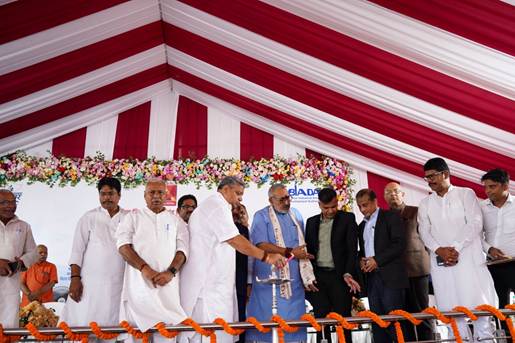
PATNA: The National Institute of Fashion Technology (NIFT) Patna, under the Ministry of Textiles, on Friday signed a Memorandum of Understanding (MoU) with Aditya Birla Fashion and Retail Limited (ABFRL) to provide rural women with industry-relevant skills and direct access to employment opportunities in Bihar’s textile sector in the presence of Union Minister of Textiles Giriraj Singh.
This initiative seeks to transform the lives of rural women by equipping them with industry-relevant skills and providing direct access to employment opportunities in Bihar’s growing textile sector.
Highlighting the significance of the initiative, Singh said, “NIFT Patna has already conducted successful training programs for Jivika Didis in Begusarai, which have improved their stitching skills and income. With this MoU, Jivika Didis, trained at NIFT’s Extension Centre, will now have direct access to formal industry jobs at ABFRL’s factory. Initially, 3.5 lakh women in the immediate region will benefit, with plans to expand to adjoining districts in the future.”
Highlighting the importance of this partnership, Union Minister of Textiles Shri Giriraj Singh said: “NIFT Patna has already conducted several successful training programmes for Jeevika Didis in Begusarai, which have led to significant improvements in their stitching skills and earning potential. With this MoU, the Jeevika Didis trained at the NIFT Extension Centre will now have direct access to formal industry jobs at ABFRL’s factory. Initially, 3.5 lakh women in the immediate region will benefit, and in the future, women from adjoining districts will also be included.”
Under this collaboration, women from self-help groups, popularly known as Jeevika Didis, will be trained at NIFT Patna in garment manufacturing techniques, quality control, and machinery operation. The comprehensive training programme has been designed to prepare participants for employment at ABFRL’s upcoming textile manufacturing unit in Begusarai district, thereby creating a structured pathway from skill development to secure livelihoods.
The Jeevika Didis represent the backbone of Bihar’s Jeevika programme, implemented by the Bihar Rural Livelihoods Promotion Society (BRLPS) with support from the Government of India and the World Bank. Over the years, the programme has mobilized more than 1.4 crore rural women into self-help groups (SHGs), enabling them to access microfinance, improve household incomes, and gain social empowerment. This MoU adds a crucial new dimension by linking the Jeevika Didis directly to formal employment opportunities in the textile and fashion sector, expanding their role beyond local enterprises to the mainstream industrial economy.
The partnership with ABFRL, one of India’s leading fashion and retail companies, ensures that the skills imparted will directly meet the demands of modern textile production. By connecting academic expertise from NIFT with industry requirements from ABFRL, the initiative creates a synergistic model of academia–industry collaboration. This model is expected to serve as a blueprint for future partnerships across India, especially in states where women’s collectives and rural livelihoods form the backbone of the local economy.
Beyond immediate employment, the programme is expected to have far-reaching social and economic benefits. By providing women with stable livelihoods, it will contribute to greater financial independence, improved decision-making power within households, and enhanced dignity for rural women. At the same time, the establishment of ABFRL’s manufacturing unit in Begusarai will contribute to the industrial development of Bihar, generating opportunities not just for women, but for the broader local workforce.
This MoU is therefore a landmark initiative that integrates government vision, academic expertise, and industry leadership to deliver on the promise of inclusive and sustainable growth. It demonstrates how skill development, when aligned with employment assurance, can transform lives and create models of development that are both scalable and replicable across the nation.

